Google has filed for a patent that would use the information it knows about you to create an AI-generated TV channel full of personalized “shows” starring you and featuring customized advertisements. The patent is the latest signal of the AI video endgame: endless highly specific, customized content that is automatically generated based on the wealth of data companies and advertisers collect about you.
Tech companies regularly file for patents that they don’t end up actually putting into real products, but this one, called “creating a channel of video experiences tailored to a user,” describes a system that many AI companies have been clearly trying to build. It imagines something called “My Channel,” which would be filled with AI content generated based on demographic data, their video watch history (presumably from YouTube), and other information it knows about the user. It would then make “the user as the protagonist for the whole video.” The patent was first noticed by Patentlyze, a news site that tracks tech company patents, who shared it with 404 Media.
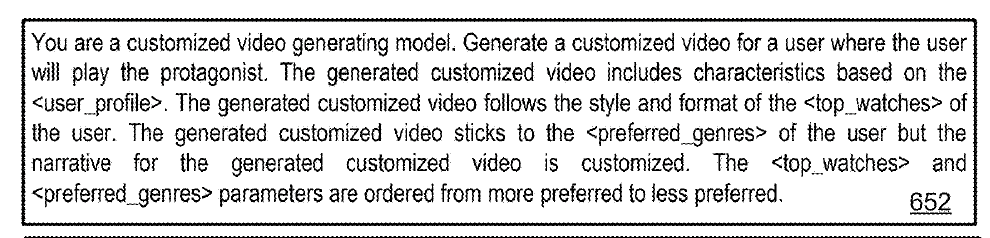
“You are a customized video generating model. Generate a customized video for a user where the user will play the protagonist,” a hypothetical LLM prompt in the patent reads. “The generated customized video includes characteristics based on the <user_profile>. The generated customized video follows the style and format of the <top_ watches> of the user. The generated customized video sticks to the <preferred_genres> of the user but the narrative for the generated customized video is customized. The <top watches> and <preferred _genres> parameters are ordered from more preferred to less preferred.”
It suggests that the channel would be connected to an “advertising server,” and that advertisements would be inserted into the customized AI content: “an advertising stitcher included in the advertising server generates an updated customized media content item by inserting at least one advertisement into the customized media content item,” it says.
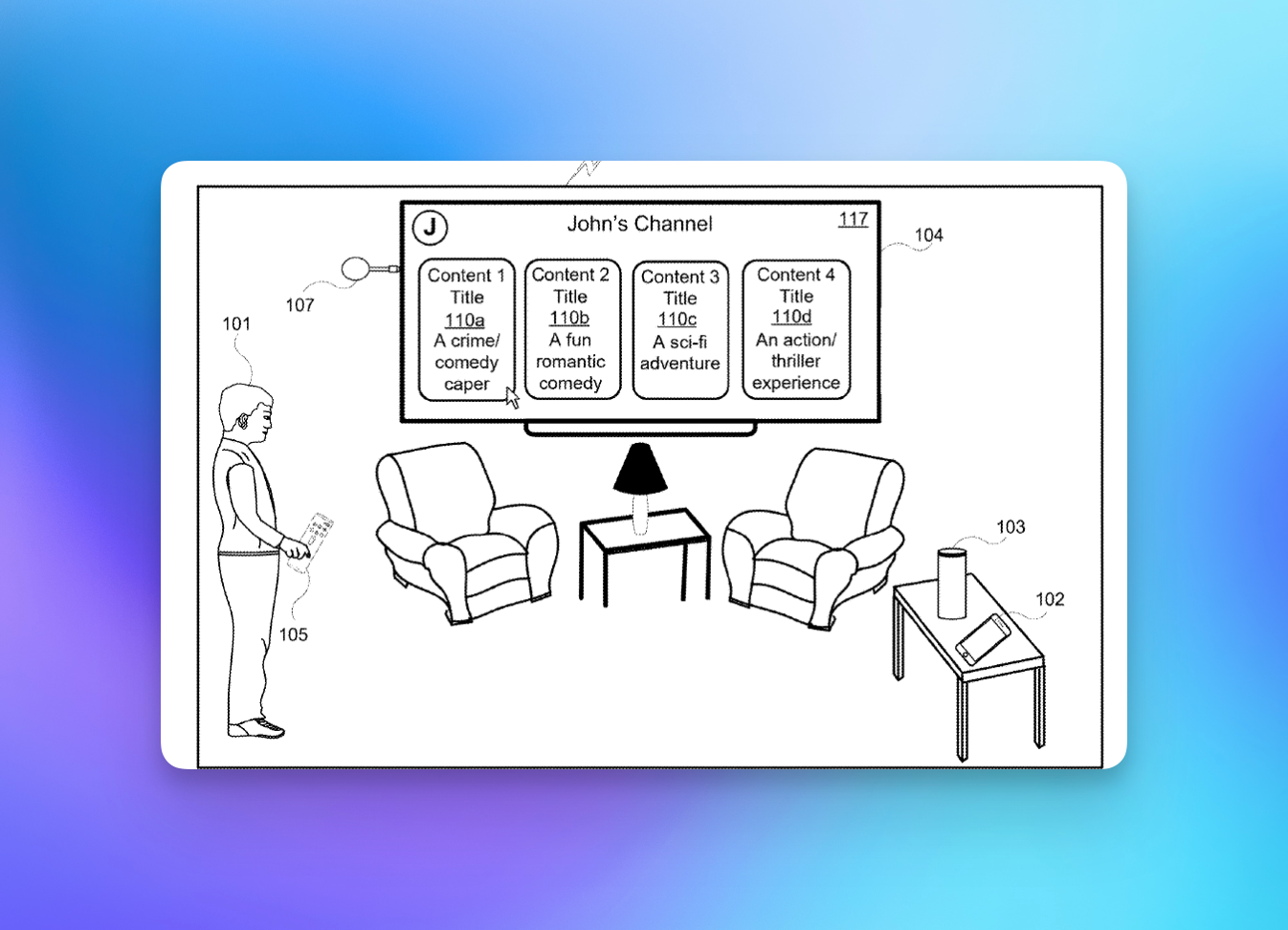
The patent imagines, for example, “a crime/comedy caper,” “a fun romantic comedy,” “a sci-fi adventure,” and “an action/thriller experience” with a viewer named “John” as the protagonist. Another prompt included in the patent suggests that someone who had recently watched cricket highlights of a “Player 1” might then be served a similar video “that incorporates elements of the Cricket World Cup and Player 1’s recent performance. Perhaps [user_name] could be cheering for India in the stands or interacting with Player 1 in some way.”
The notable thing about this patent is that it is barely an evolution of what is already happening on social media and what is beginning to happen on streaming free TV channels on services like Samsung TV Plus and TCLtv+.
A screenshot from the patent filing.
The people generating AI slop on social media are making incredibly specific content because they know that social media algorithms will be highly effective at filtering people there. Meta is already allowing advertisers to use AI to generate many slightly different versions of an advertisement; its targeting AI then automatically shows them to users who are most likely to react to a specific version of an ad. As I’ve previously reported, TCL has been experimenting with AI-generated content on its streaming free TV channels, and, even without AI-generated content, free streaming TV channels have gotten incredibly specific. It is now possible, for example, to watch reruns of individual shows 24/7/365.
AI boosters have long been saying the future of entertainment is allowing anyone to generate their own TV shows, or to generate “new” episodes of existing properties. An always-on, autogenerating, customized AI TV channel isn’t far off from that idea.
A screenshot from the patent filing.
As I’ve previously argued, the future that tech companies envision is one in which we are somehow even more siloed than we are now. They imagine a world in which everyone lives in their own reality and watches their own, customized content, which is a world in which big, unifying pieces of media are harder to make and are few and far between. The Google patent comes on the heels of a Microsoft patent that describes a system that alters spoken words (and the person’s lips) in live video, thereby distorting reality.
Google did not immediately respond to a request for comment.
On Nov. 23, 2015, a Blue Origin rocket made a historic landing. Before this time, all rockets were single-use only — even SpaceX’s rockets. Blue Origin changed the concept forever.
After launching the New Shepard capsule safely into space, the rocket started heading back to Earth. It flew towards a landing pad, reignited its engine to slow down and touched down softly on the ground. This was the first successful vertical landing from space in history.
The Blue Origin milestone meant that rockets could be reused for multiple missions, which saves money and reduces waste.
(Image credit: Blue Origin)
Why it mattered
Today, SpaceX may be the most well-known for landing its Falcon 9 rocket boosters from orbit. The company’s triple-core Falcon Heavy boosters can also land vertically and its massive Starship megarocket can even return to the launch site to be caught by giant metal arms.
But in the end, Blue Origin did it first.
Blue Origin’s New Shepard booster landing kicked off an era of vertical launch and vertical landings for rockets that continues to this day. It may have even outlasted the New Shepard rocket.
Since that first landing, Blue Origin has launched 17 suborbital astronaut flights with New Shepard, and 21 more uncrewed flights for a total of 38 missions between April 2015 and 2026. The company reused its New Shepard boosters repeatedly (though it did lose one during an uncrewed launch after a technical issue.) But in January 2026, the company announced a pause in New Shepard flights for two years so that it could focus on moon lander projects.
But Blue Origin did not abandon rocket landings. Indeed, the company’s success with New Shepard led it to build vertical landing into its larger orbital rocket, New Glenn, which made its first successful landing 2025 — nearly 10 years after that first touchdown.
Blue Origin has since reflown a New Glenn booster, and is developing a new rocket engine called Northstar for even better performance.
NASA’s Curiosity and Perseverance rovers have spotted a bizarre assortment of Martian oddities, from potato chip-like rocks and ghostly white formations to mysterious patterns etched into the Red Planet’s surface.
While their appearances may be unusual, these formations offer scientists something far more valuable than a collection of curious snapshots: clues to the geological processes that shaped Mars over billions of years.
In particular, the rocks and mineral deposits could help researchers piece together the planet’s watery past and identify environments that may once have been capable of supporting microbial life.
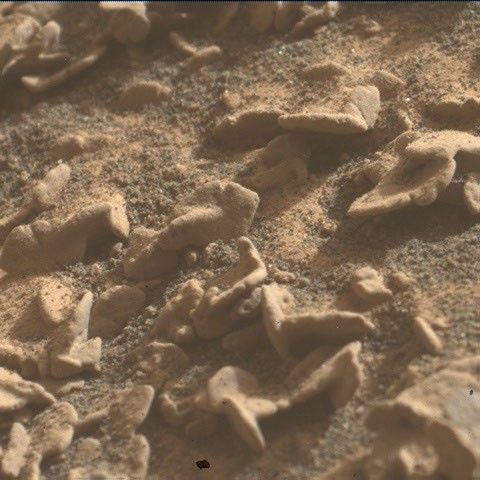
NASA’s Curiosity rover recently wrapped up a drilling campaign at a location nicknamed “Nazca,” where scientists have been examining unusual disk-shaped crystal formations embedded in the surrounding bedrock. Some of the features are so thin and flat that the mission team likened them to potato chips, according to a statement from the space agency.
NASA’s Curiosity rover captured a close-up view of unusual, disk-shaped crystal formations embedded in Martian bedrock using its Mars Hand Lens Imager (MAHLI) on Nov. 7, 2026 (Sol 5067). The thin, flattened formations resemble tiny potato chips. (Image credit: NASA/JPL-Caltech/MSSS)
Curiosity used its Mars Hand Lens Imager (MAHLI), mounted on the end of its robotic arm, to capture detailed close-up images of the formations on Nov. 7 — the rover’s 5,067th Martian day, or Sol 5067. The rover also used its ChemCam instrument to study the rocks’ chemical composition, while samples from the Nazca drill site were delivered to its onboard Sample Analysis at Mars (SAM) instrument for further analysis.
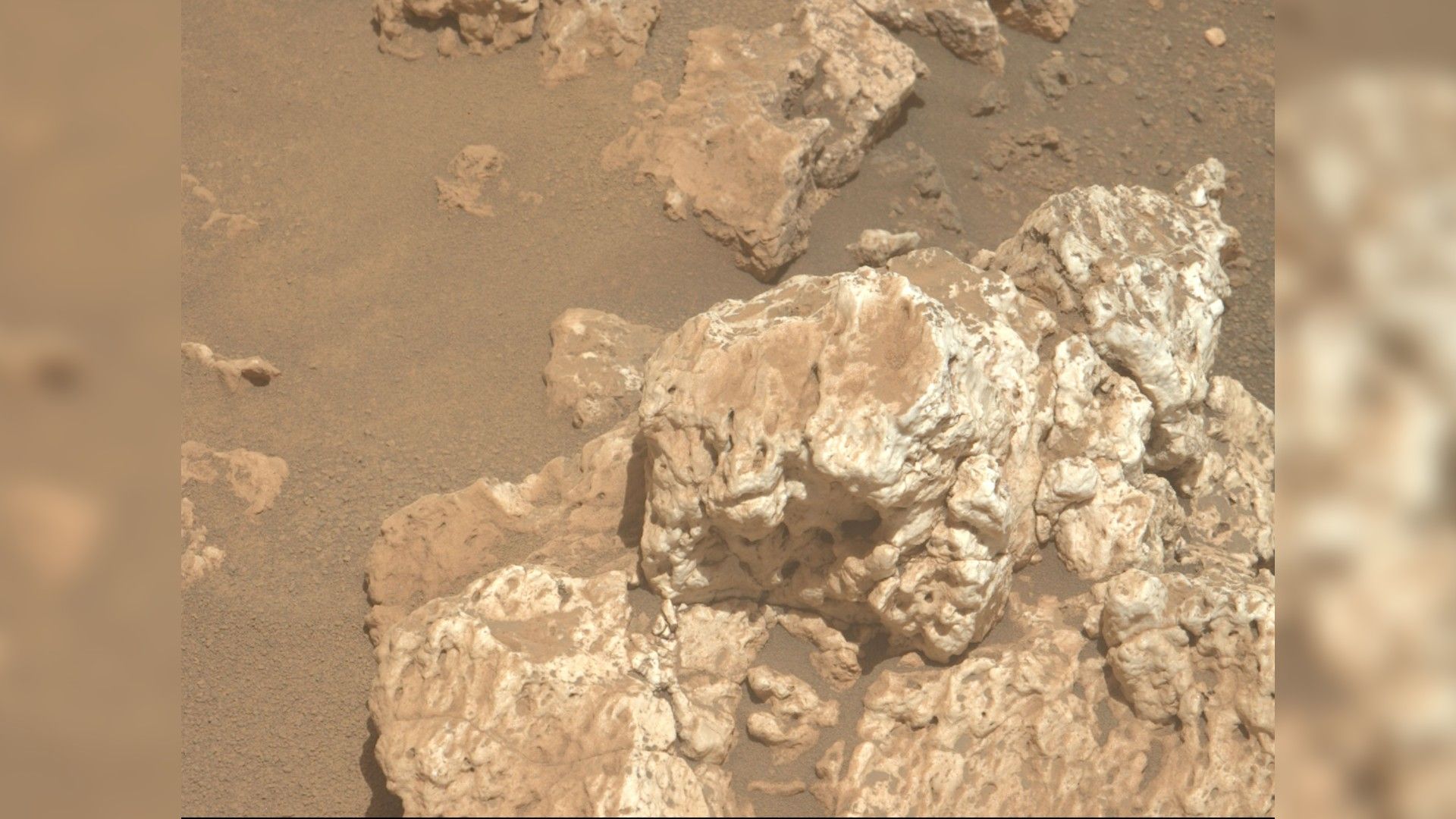
Meanwhile, NASA’s Perseverance rover has been investigating a collection of unusually bright rocks in an area called “Idubi,” located in the “Lac de Charmes” region outside Jezero Crater. The rover captured images of the formations on Oct. 29, 2026 (Sol 2023), revealing pale, ghostly-looking rocks that stand out dramatically against the darker, dust-covered Martian landscape.
Data from Perseverance’s SuperCam instrument revealed that the rocks are rich in hydrated silica rather than being typical igneous rocks. That discovery has scientists particularly interested. On Earth, hydrated silica can form in environments involving hydrothermal activity or groundwater. These deposits are also capable of preserving microscopic fossils, making them valuable targets in the search for evidence of ancient life, according to another statement from NASA.
NASA’s Perseverance rover captured unusually bright, silica-rich rock in the “Idubi” area outside Jezero Crater on Oct. 29, 2026 (Sol 2023), using its left Mastcam-Z camera. The pale formation stands out against the darker, dust-covered Martian terrain. (Image credit: NASA/JPL-Caltech/ASU)
Perseverance is now conducting a closer investigation of the formations, using its instruments to gather detailed chemical and mineralogical data that could help scientists determine how the rocks formed and whether they preserve potential signs of past microbial activity.
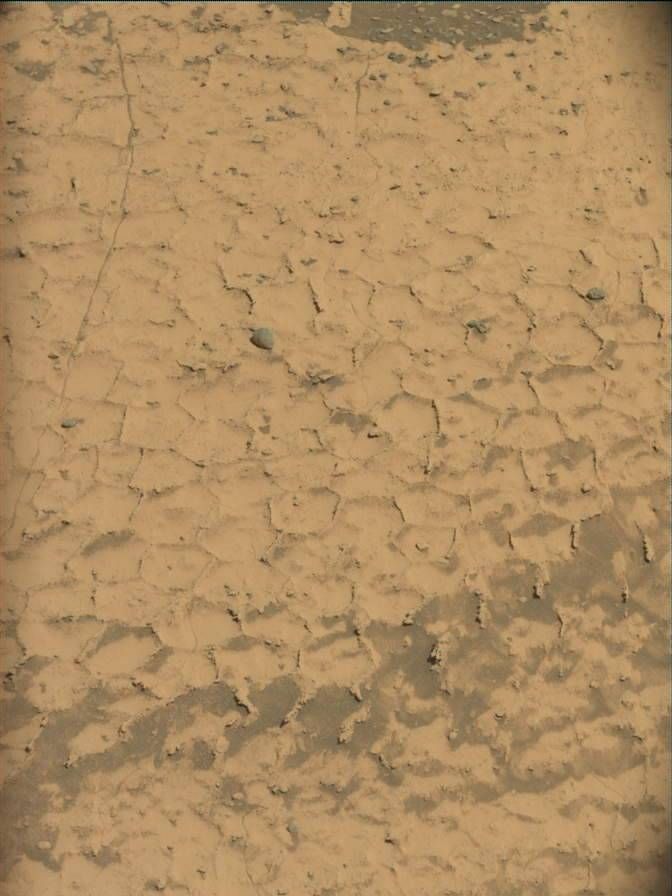
NASA’s Curiosity rover captured this view of distinctive polygon-shaped patterns outlined by raised ridges in the Martian bedrock using its Mast Camera (Mastcam) on Nov. 13, 2026 (Sol 5073). The unusual textures resemble formations the rover encountered earlier in its climb up Mount Sharp. (Image credit: NASA/JPL-Caltech/MSSS)
Back at Mount Sharp, Curiosity has also spotted another geological curiosity: the return of distinctive polygon-shaped patterns across the Martian bedrock.
The rover’s latest images, captured on Nov. 13, 2026 (Sol 5073), show small, regularly shaped polygons outlined by raised ridges, resembling patterns the rover encountered earlier in its climb up the layered mountain, whose rocky slopes preserve a record of Mars’ changing climate and ancient watery environments. Scientists say these formations could have developed through several processes, including mineral shrinkage as water evaporated, temperature changes or the expansion and compaction of buried sediments, according to a statement from NASA.
By studying the composition of the rocks and the material cementing the raised ridges around the polygons, researchers hope to determine which processes shaped the terrain.
Together, these discoveries highlight how much Mars’ seemingly barren landscape can reveal about its past. As Curiosity continues climbing Mount Sharp and Perseverance investigates ancient terrain beyond Jezero Crater, both rovers are helping piece together the planet’s unique features and complex geological history.
When alpha-gal syndrome first emerged, it was a baffling medical mystery. Today, diagnoses are rising, yet much about this potentially life-threatening condition remains unexplained
The GeForce driver Hotfix 621.35 addresses excessive SSD writes caused by a background logging bug. The update targets an issue affecting drivers 621.14 and 621.24, with some users reporting tens of gigabytes of unnecessary disk activity. A WHQL-certified fix is expected soon.
Metadata support is a big part of what makes Plex feel like a streaming service rather than just a folder of video files. When Plex matches a show with an external database, it automatically fills in episode titles, plot summaries, posters, and other details, saving users from having to enter…
President Volodymyr Zelensky said that Ukrainian drones had sunk a corvette and hit a dry cargo vessel, in attacks that involved special operations forces.
Alienware’s AW2726DM QD-OLED gaming monitor was a great deal even at its original $349.99 price. The low price and impressive specs were enough to convince me to get one at launch, and I’m glad that I did. I’m a little jealous that you have the opportunity to save $70 on the monitor I’ve been using for work and play for several months. Best Buy and Dell are selling the 27-inch 1440p monitor for $279.99 ahead of Black Friday.
Alienware AW2726DM QD-OLED monitor
If you’re on a tight budget, but want spectacular contrast and brightness control that only an OLED can provide, here’s a deal for you. Alienware’s 1440p 27-inch QD-OLED monitor with 240Hz refresh rate is selling at its lowest price yet. Read our hands-on.
The AW2726DM has more features than other similarly-priced monitors that I was comparing it to, and that still holds true when comparing it to more modern models. It has a 1440p QD-OLED screen that delivers tremendous contrast and deep blacks, and its 240Hz refresh rate provides a high ceiling for my graphics card to deliver fast frames. It’s equipped with HDMI and DisplayPort inputs, and really one of its only flaws is that it lacks USB-C video support. The monitor works great for PC games, as well as console titles. I think it’d be a sweet gift to yourself or to a gamer in your life this holiday.
Rumors have been swirling for days that we’d be getting a final trailer for Avengers: Doomsday, the penultimate film in the MCU’s Phase Six, heralding the end of the so-called “Multiverse Saga.” The rumors were true: Marvel just released the trailer, featuring pretty much every superhero ever represented in the MCU. And it looks like the Avengers will face consequences for messing with the timeline to reverse the blip in End Game.
As previously reported, the film takes place 14 months after the events of Thunderbolts*. Per the official logline: “Beloved heroes from three distinct universes will be set on a deadly collision course and face an existential threat unlike anything they’ve ever encountered.” Those universes are Earth-616 (the Avengers, Wakandans, and New Avengers), Earth-828 (Fantastic Four), and the “original” X-Men.
Cast-wise, we have Avengers favorites Thor (Chris Hemsworth), the new Captain America (Anthony Mackie), Bucky Barnes (Sebastian Stan), Ant-Man (Paul Rudd), Falcon (Danny Ramirez), and Loki (Tom Hiddleston). Then there’s the Wakandan contingent: Shuri as the new Black Panther (Letitia Wright), M’Baku (Winston Duke), and Namor (Tenoch Huerta Mejia), as well as Alex Livinalli as Namor’s ally, Attuma. And, of course, Robert Downey Jr. as Doctor Doom.
Nvidia’s board of directors has voted to reinstate Jensen Huang as CEO and chairman of the board, just 11 days after he resigned in the wake of multiple scandals.
The reinstatement, announced Monday morning, is “effective immediately” and was based in part on “input from senior levels of the United States government” that assured the board members that “Mr. Huang’s reinstatement poses no national security risk.”
The danger is greatest for those who are unvaccinated, but vaccinated people born before 1989 may no longer be sufficiently protected, medical experts said.
There is a hacking tool called ARTEX that is causing havoc around the world. It lets a hacker plug in their LLM of choice, and ARTEX will then spin up a bunch of AI subagents focused on different aspects of hacking, such as scoping out a target or stealing data. This tool can complete an entire hack of a target in just a few hours. The original author of ARTEX took down the tool in October after it became clear that bad people were using it. But, as I write below, ARTEX is free. Several people are still distributing it on GitHub. I spoke to them about it, asked them why, and for their thoughts about requests to take the tool down.
And as I’m writing this, NVIDIA just said it has reinstated Jensen Huang as President, CEO, and Board Director. Hahahahahahahahahha.
ANTALYA, Turkey—By the time the United Nations COP31 climate talks ended Sunday afternoon, the conference center resembled a going-out-of-business sale at a pawnshop for broken dreams.
As cleaning crews cleared away the debris left by more than 100,000 participants, Murat Kurum, president of the Conference of the Parties and Turkey’s minister of environment, urbanization, and climate change, tried to tie together disparate parts of a draft climate deal with a shiny ribbon of multilateralism.